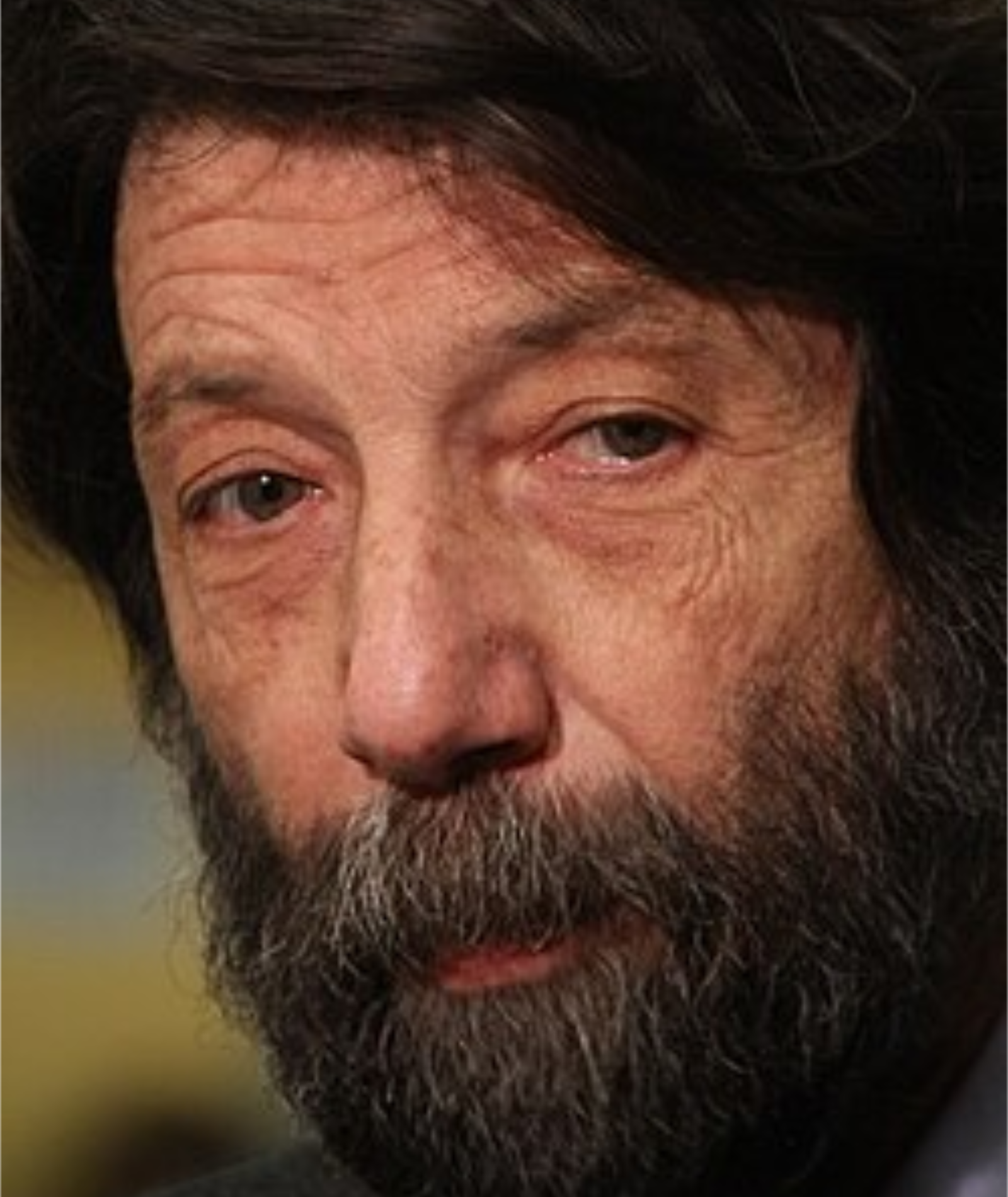
Massimo Cacciari
Philosopher
Studies and beginnings Of Emilian ancestry on his father's side (his grandfather Gino Cacciari, from Medicina, had moved to Venice to run the city's shipyards), he is the son of Pietro, a pediatrician, and of a housewife who came from a family of artists. He has a younger brother, Paolo, who was deputy mayor of Venice and a deputy for Communist Refoundation. After attending the Marco Polo classical lyceum in Venice, he graduated in philosophy in 1967 from the University of Padua, with a thesis on Immanuel Kant's Critique of Judgment, supervised by Dino Formaggio. While still a student, he was an assistant to professors Carlo Diano, Sergio Bettini and Giuseppe Mazzariol. Academic career In 1980 he became associate professor of aesthetics at the Institute of Architecture of Venice, where in 1985 he became a full professor. In 2002 he founded the Faculty of Philosophy of the Vita-Salute San Raffaele University in Cesano Maderno, of which he was dean until 2005. He is among the founders of several journals of political philosophy that shaped the debate from the 1960s to the 1980s, including Angelus Novus, Contropiano, il Centauro and Laboratorio politico. At the center of his philosophical reflection lies the crisis of modern rationality, which has proved incapable of grasping the ultimate meaning of the real, abandoning the search for the foundations of knowing. His vision moves from the concept of "negative thought", identified in the philosophies of Friedrich Nietzsche, Martin Heidegger and Ludwig Wittgenstein, in order to trace its premises back to certain aspects of the Western religious tradition and philosophical thought. He has published numerous works and essays, among which the following deserve particular attention: Krisis (1976); Pensiero negativo e razionalizzazione (1977), Dallo Steinhof (1980), Icone della legge (1985), L'angelo necessario (1986), Dell'inizio (1990), Della cosa ultima (2004) — winner of the Premio Cimitile —, Hamletica (2009), Labirinto Filosofico (2014); Il Lavoro dello Spirito (2020) is his most recent writing. The volumes Icone della legge and L'angelo necessario also contain some pages dedicated to the philosophy of the icon and to the outcomes of the thought of the Russian mystic Pavel Aleksandrovič Florenskij. Among his numerous honors are the honoris causa degree in architecture conferred by the University of Genoa in 2003, the honoris causa degree in political science conferred by the University of Bucharest in 2007 and the honoris causa degree in philology, literature and classical tradition conferred by the University of Bologna in 2014. He is currently president of the Gianni Pellicani foundation and teaches Philosophical Thinking and Metaphysics at the Faculty of Philosophy of the Vita-Salute San Raffaele University of Milan, of which he was also deputy vice-chancellor. Political career In Potere Operaio and in the PCI As a young man he was a militant politician and, together with the Montedison workers, occupied the Mestre station. In the 1960s he collaborated on the monthly magazine Classe operaia and, after internal disputes among Mario Tronti, Alberto Asor Rosa and Toni Negri (an encounter that was essential to his formation), he directed, together with Asor Rosa, the magazine — described as one of "Marxist materials" — Contropiano, with which an attempt was made to reunify the group. But the attempt failed, and the Veneto group transformed the magazine into the newspaper Potere Operaio ("Political newspaper by the workers of Porto Marghera"), which Cacciari, disappointed, did not join. He later entered the Italian Communist Party, holding positions apparently far from his philosophical interests: head of the Industry Commission of the PCI of Veneto in the 1970s, he was then elected to the Chamber of Deputies from 1976 to 1983, and was a member of the Chamber's Industry Commission. Mayor of Venice (1993-2000) In 1993 he ran for mayor of Venice at the head of a coalition made up of the Democratic Party of the Left, Communist Refoundation, the Greens, the Socialist Party, Democratic Alliance and La Rete. In the first round, on 21 November 1993, he gathered 46.29% of the vote, against 26.5% for his opponent Aldo Mariconda, backed by the Lega Nord. In the run-off, on the following 5 December, he won with 55.37% of the votes, against 44.63% for his challenger. In 1997 he was confirmed for a new term, gathering 64.58% of the votes, against 20.71% for his main antagonist, Mauro Pizzigati, at the head of a coalition made up of Forza Italia, National Alliance and Alleanza Civica di Centro (CCD - CDU - Patto). Mayor until 2000, he ranked among the main supporters of Romano Prodi's I Democratici, so much so that there was talk of him as a probable leader of the Ulivo (Olive Tree coalition). From the very beginning of his political activity he saw in federalism a tradition to be recovered for Italian progressives, whereas a large part of the leaders of the left saw in this attention to federalist ideals a brake on electoral support in the center-south. In preparation for the 2000 regional elections, he was convinced that, in order to win in a traditionally moderate region, the left would have to attract part of the electorate fleeing the former DC, and to this end he tried to "open up" to an alliance with the Lega Nord (later disapproved of by the Italian center-left), and took some significant steps in this political direction, but he did not fully manage to convince the autonomist electorate. In 1997 he decided to carry out the project of building the Calatrava bridge, a work that has aroused continual controversy and the interest of the Court of Auditors over the years. Member of the European Parliament and Veneto regional councillor In the 1999 European elections he ran with the I Democratici list, being elected in two constituencies; he then opted for the north-western one. His defeat in the 2000 regional elections, when he was a candidate for the presidency of the Veneto region, dashed the hypothesis that he might become the future leader of the Ulivo. In that round Cacciari obtained 38.2% of the votes, being defeated by the representative of the Casa delle Libertà, Giancarlo Galan, who received 54.9% of the vote. On that occasion Cacciari obtained a seat as a regional councillor, which he chose to keep: for this reason he resigned, due to incompatibility, from the European Parliament. Mayor of Venice (2005-2010) In 2005 he announced his intention to run for mayor of Venice for the third time. The left-wing parties of the Ulivo, however, had already reached an agreement on the unitary candidacy of the magistrate Felice Casson, but Cacciari declared that he did not want to give up his own candidacy, even at the cost of splitting the coalition's unity, as indeed happened, with Cacciari supported by UDEUR Popolari and La Margherita and Casson backed by DS, the Greens, PRC and SDI. In the first round Casson had 37.7% of the votes, while Cacciari stopped at 23.2%: thanks to the divisions within the center-right, even sharper in Venice, it was the two center-left representatives who went to the run-off. Surprisingly Cacciari, although supported by weaker lists, managed to leverage the moderate electorate and won the contest with a 1,341-vote lead over his competitor (50.5% against 49.5%). The unexpected victory of the politician-philosopher caused ill feeling within the coalition (Casson commented on the result by exclaiming: "Cacciari won? Then the right has won!"), and a peculiar situation in the Venetian city council: La Margherita, with 13.4% of votes, was entitled to as many as 26 seats, while the DS, which had obtained 21.2%, had to settle for 6 seats; and the UDEUR, despite a modest 1.4%, grabbed 2 seats, unlike Forza Italia, 4 seats with 20.51%, Communist Refoundation, which with 6.8% won a single seat, and National Alliance, no seats with 6.5%. Overall, therefore, the Cacciari coalition, with 14.8% of the vote, was entitled — thanks to the electoral law — to 28 seats out of 46. This allowed Cacciari, a member of La Margherita, of which he was a leading figure in Veneto, to govern the city with a council majority. On the occasion of the subsequent 2005 regional elections, the 2006 general elections and the 2007 local elections, Cacciari highlighted what he called the northern question. On 2 November 2009, disappointed by the evolution of the Democratic Party, he announced that he would abandon active politics after the end of his term as mayor, which occurred in April 2010. Fairly severe was the policy conducted by his council against unauthorized street vendors, and highly contested were also the ordinances that, for the sake of urban decorum, imposed a ban on selling take-away food in Piazza San Marco, on going around bare-chested and on lying down on the ground. Moreover, in 2007, with the creation of the Rome Film Festival by the then mayor Walter Veltroni, he expressed displeasure at the prospect of the Venice International Film Festival being overshadowed by it. There were not a few frictions with the Lega Nord over his intention to build a Sinti camp in Mestre. Famous was the campaign that promoted the use of public water as opposed to buying bottled water. To him is owed the restoration of Palazzo Grassi and of Punta della Dogana. On 23 July 2010, in Mogliano Veneto, he presented the political manifesto Verso Nord, un'Italia più vicina, aimed at those who identified neither with the PD nor with the PdL and wanted a policy for the North different from that pursued by the Lega. The manifesto was then transfused into a political party called precisely Verso Nord, officially founded on 12 October 2010.
Sources
- Wikipedia — Massimo CacciariConsulted for a biographical summary.