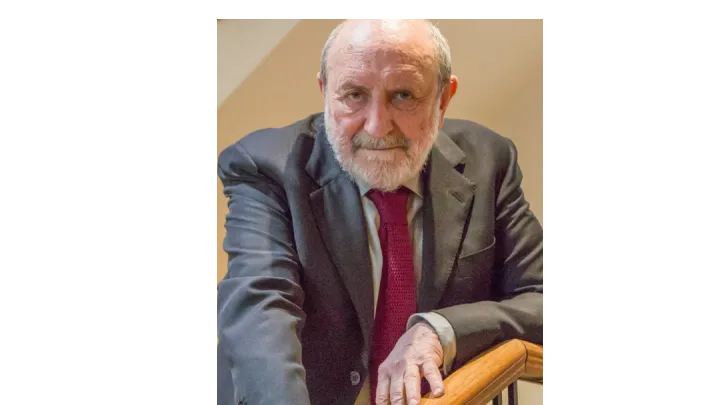
Umberto Galimberti
Philosopher and psychoanalyst
Of humble origins, he was born in Monza in 1942 into a family of ten children: his mother was a primary-school teacher and his father — who died prematurely in 1955 — did various jobs. The family's needs forced Umberto, like his siblings, to work from an early age. It was thanks to the generosity of a priest that Umberto was able to attend secondary school in a seminary, where he became a lifelong friend of the theologian Gianfranco Ravasi. Having completed his classical secondary studies in 1961, and thanks to a scholarship of eight hundred thousand lire, he enrolled in the philosophy degree programme at the Catholic University of Milan, but after only two years he was forced to interrupt his studies for lack of money. He therefore spent a period of time in West Germany, where he worked as a labourer in a large factory in order to earn the money he needed to cover his university expenses, and so managed to resume his studies. In 1964, moreover, he worked as a philosophy teacher at the Zucchi lyceum in Monza. In 1965 he graduated with honours, under Professor Emanuele Severino, with a thesis entitled La logica filosofica di Karl Jaspers; among his teachers were also Gustavo Bontadini and Sofia Vanni Rovighi. With another scholarship, won in 1963, he simultaneously attended the University of Basel until 1965, where he came into contact with the psychiatrist and philosopher Karl Jaspers, of whom he would later become one of the leading Italian translators and popularisers, and who advised him to explore the links between psychopathology and philosophy — a theme he would later pursue also under the supervision of Eugenio Borgna, one of the foremost Italian representatives of the phenomenological approach in psychology and psychiatry. In 1967, having won the post, he became a professor of history and philosophy at the state Bartolomeo Zucchi lyceum-gymnasium in Monza, where he taught until 1979, when he won a national university competition for associate professor of moral philosophy. On the proposal of Emanuele Severino, in 1976 he was appointed lecturer in cultural anthropology at the newly founded Faculty of Arts and Philosophy of the Ca' Foscari University of Venice, then associate professor of philosophy of history in 1983, taking up the chair in 1999 after obtaining the full professorship in this discipline. From 2002 he also held teaching posts in general psychology and dynamic psychology, alongside his teaching in moral philosophy. Since 2015 he has been professor emeritus of the Ca' Foscari University of Venice. In 1976 he also began a psychoanalytic path of personal analysis and training at the Italian Centre for Analytical Psychology (CIPA) at its Rome branch, with trainer Mario Trevi, which he concluded in 1985, when he became an ordinary member of the International Association for Analytical Psychology, as well as an analyst member of CIPA (Milan branch). From 1976 to 1979 he also attended the psychiatric hospital of Novara, then directed by Eugenio Borgna. Since 2003, moreover, he has been vice-president of the Italian Association for Philosophical Counselling “Φρόνησις”, inaugurating in 2006, with Luigi Perissinotto, the first university master's programme in philosophical counselling at the University of Venice. He collaborated weekly with Il Sole 24 Ore from 1987 to 1995, the year in which he began his collaboration — still ongoing today — with la Repubblica, both with editorials on current affairs and with in-depth pieces of a cultural nature. He also edits the letters column of D — la Repubblica delle donne, the weekly supplement of la Repubblica. In 2002 he was awarded the international prize “Maestro e traditore della psicoanalisi” and, in 2011, the Ignazio Silone prize for culture. On 21 June 2017 he took part as a speaker in the conference organised in Perugia by the Grande Oriente d'Italia on the occasion of the tercentenary of the founding of the Grand Lodge of London. His wife, Tatjana Simonič (Trieste, 1946 – Milan, 2008), who was a full professor of molecular biology at the University of Milan, took an active part in the writing of the famous Dizionario di Psicologia on which Galimberti worked from the 1980s, with the first edition published by UTET in 1992, then a more extensive edition with Garzanti in 1999, up to the latest edition of 2018 published by Feltrinelli.
Sources
- Wikipedia — Umberto GalimbertiConsulted for a biographical summary.