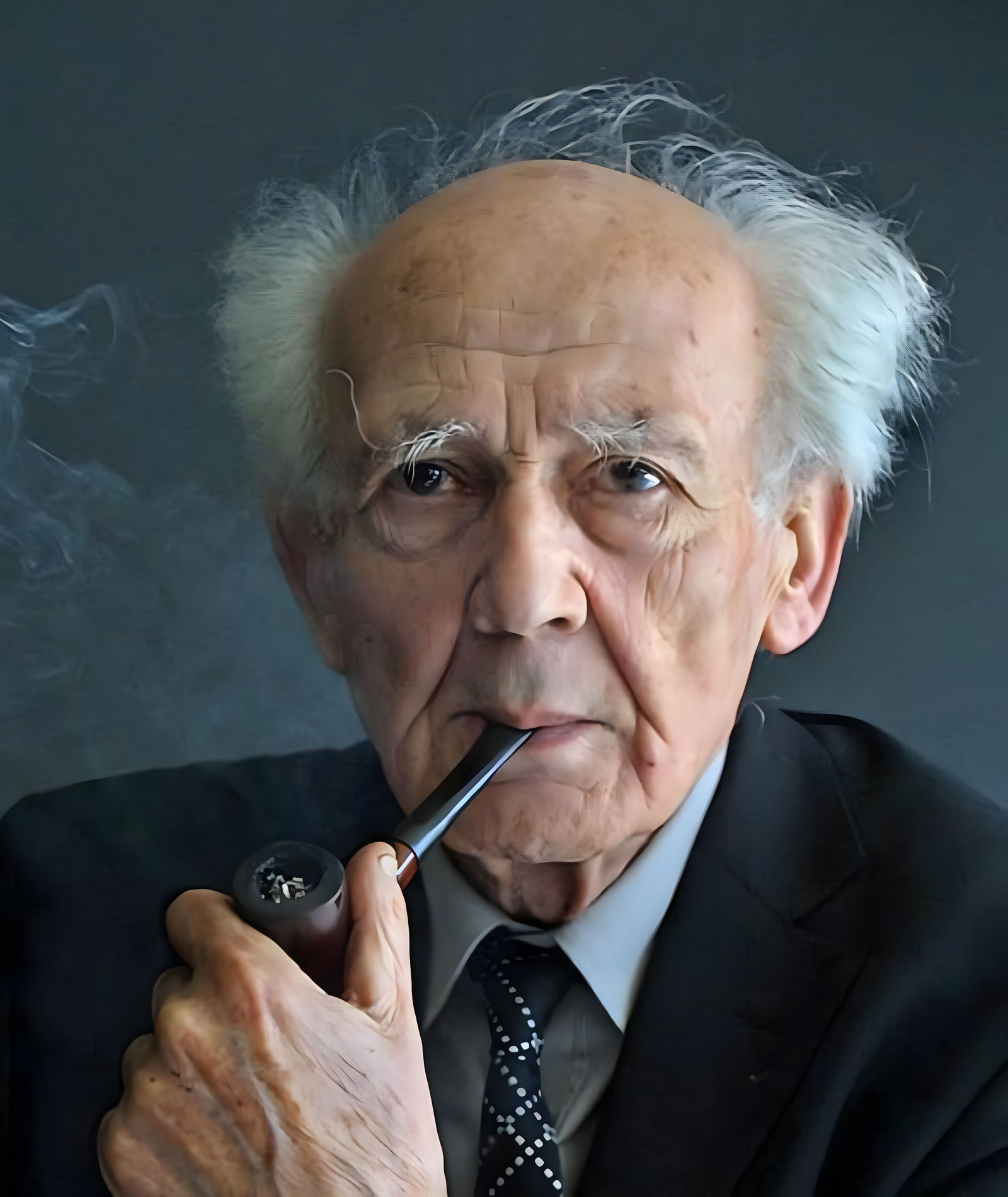
Zygmunt Bauman
Philosopher
Bauman was born in Poznań, in what was then the Second Polish Republic, in 1925, into an Ashkenazi Jewish family. At the outbreak of the Second World War in September 1939, when the country found itself divided between Nazi Germany on one side and the Soviet Union on the other, Bauman took refuge with his family in the zone under Red Army occupation, so as to escape the Nazi round-ups. During the course of the war he decided to take an active part in the ongoing military operations and therefore enlisted in a Soviet military unit, and then, from the end of the conflict until 1948, carried out certain operational tasks for Soviet military intelligence; the nature, as much as the extent, of this collaboration nonetheless remain unknown to this day, as do the exact circumstances in which it was ended. In the post-war period he began to study sociology at the University of Warsaw, where Stanisław Ossowski and Julian Hochfeld taught. During a period of study at the London School of Economics, he prepared his major dissertation on British labour and the intrinsic dynamics of the related workers' and trade-union movements, which was published in 1959. As a graduate and qualified scholar, Bauman collaborated with numerous specialised journals, including the popular Socjologia na co dzień (“Everyday Sociology”, 1964), which reached a wider audience than the traditional academic circuit. He was initially a follower of Marxism-Leninism, the official ideology of the various countries of the Eastern Bloc, which he then came to revise radically — and finally to abandon — following his critical discovery of the thought of Antonio Gramsci and of the neo-Kantian sociologist Georg Simmel. During the period of de-Stalinisation, he became a fierce critic of the political regime in his own country. He nonetheless continued, until the end of his days, to declare himself a socialist of Marxist stamp. In March 1968, the incessant resurgence of antisemitism at the various levels of Polish society, also used in internal political struggle, drove many Polish Jews to emigrate abroad; among them, many intellectuals who had distanced themselves from the regime. Bauman, who had lost his chair at the University of Warsaw, was one of these. He therefore emigrated first to Israel, to teach at Tel Aviv University, and later accepted a chair of sociology at the University of Leeds, where he was a professor from 1971 to 1990. From 1971 he almost always wrote in English. Towards the end of the 1980s he earned an international reputation thanks to his studies concerning the connection between the culture of modernity and totalitarianism, in particular on Nazism and the Holocaust. He eventually also obtained British citizenship. He died on 9 January 2017, at the age of 91, in the city of Leeds, where he had lived and taught on a permanent basis for a long time.
Sources
- Wikipedia — Zygmunt BaumanConsulted for a biographical summary.